
Give It a Rest
Rest and Recovery Are Important to Any Successful Exercise Regimen


Fitness News from Around the Web
Fitness Tech
The Peloton Guide is Officially Available - The Peloton Guide has officially launched. The Guide is a camera that connects via HDMI to your TV and allows you to see yourself side-by-side on your television screen with a Peloton strength instructor. It was initially rumored to cost $495, but comes in at a much more affordable $295. There are additional price points that include weights and other accessories. The Verge has a balanced review of the device. My verdict based on what I’ve seen and read is that while it can certainly be useful to see how your form stacks up compared to that of the instructor’s, it would infinitely more useful to receive real-time feedback on your form. This could be something that is added later, but for now, you can probably save your money.
What we bought: Peloton’s Lanebreak offered just the kick I needed to get back in the saddle - Nicole Lee of Engadget writes, “Perhaps the best part of Lanebreak is that it got me back cycling after several months of not doing so. It really made me fall in love with cycling all over again.” Lanebreak is Peloton’s gamified workout experience and is available to anyone with a Peloton bike and an active membership.
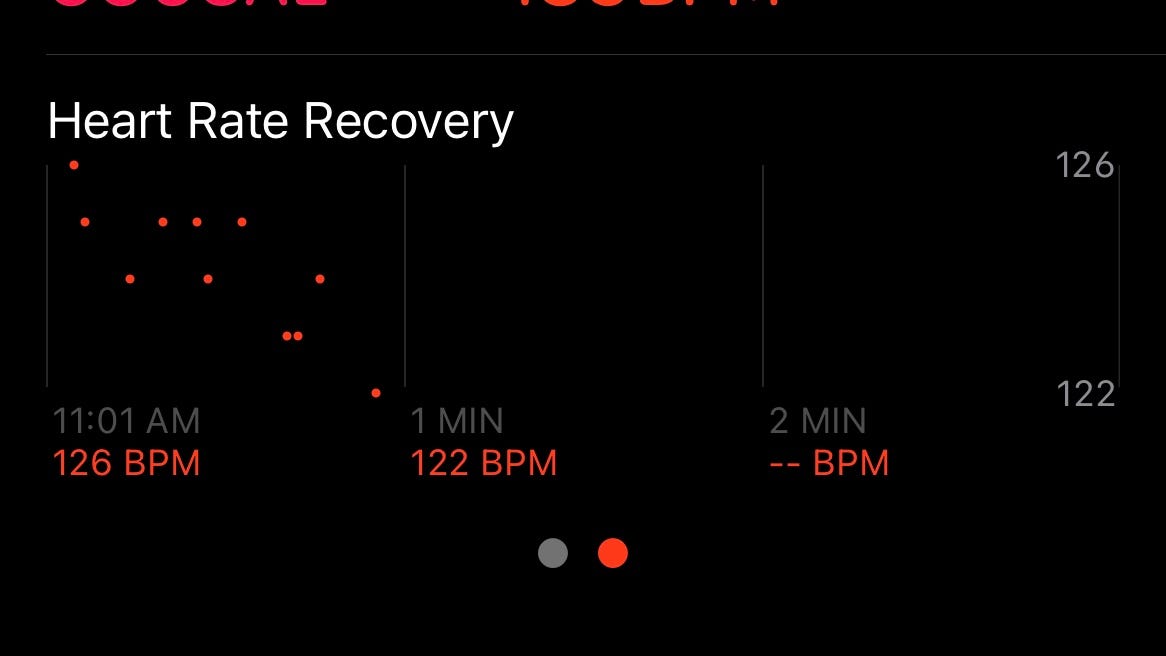
What is Apple Watch heart rate recovery? Here’s why it’s important and how to use it - This is a really good piece on heart rate recovery, how it’s tracked by your Apple Watch and what it means. Abnormally low HRR was found as a predictor of individuals being twice as likely to die within six years in one of the most cited studies from Cole, Blackstone, Pashkow, Snader, and Lauer.
Nutrition
These New Drinks Are Taking Over Your Grocery Store's Alcohol Aisle - During “Dry January,” (which I’ve subsequently turned into Dry 2022 so far) I discovered a number of beer and spirit alternatives that are surprisingly great. Now, “mocktails” are making their way to grocery shelves. From the article: “Recently, several brands, including Kin, Curious Elixirs, and Proposition Cocktail Co., have combined booze-free living and nootropics into drinkable beverages that allow non-drinkers the comfort of sipping and socializing while not actually becoming inebriated. The fad has already taken off in Silicon Valley and is expected to spread.”
Exercise
What is the difference between training and exercising? - Nothing earth shattering here, but I’ve heard the terms used interchangeably so I was curious. From the article: “Training is a method of exercising with a more specific purpose or end goal. Exercising as part of a training plan is much more strategic; think of it as exercising with the long game in mind.”
10 chest exercises to tone your upper body and improve posture - All of the chest exercises referenced in this article can be done with no weight or light dumbbells.
The Difference Between Rest and Recovery - This is a good primer on my big read today on the importance of rest and recovery. I’m terrible at resting (definitely better at recovery), but I’m working on it!
The Big Read
I’ve previously written about my struggles with rest days and the thinking that I should be doing some form of exercise every day. Part of the reason is the fact that I didn’t want to give up my exercise or move streak (Apple Watch), but I also feel better (physically and mentally) when I exercise. With that said, I’ve read a ton on the importance of rest days and recovery days over the past several weeks and I’m firmly in the corner of incorporating both into your exercise routine.
The difference between rest days and recovery days, simply put, is that a rest day is a day where you take a break from exercise. A recovery day is a day where you exercise at a reduced intensity (lower impact), stretch or meditate. Prior to incorporating rest days, here is what my workout week would look like (7 days).
Chest and Back (Weights), Cardio and Stretch - High Intensity
Shoulders and Arms (Weights), Cardio and Stretch - High Intensity
Bodyweight (No Weights), Cardio and Stretch - Medium Intensity
Chest and Back (Weights), Cardio and Stretch - High Intensity
Shoulders and Arms (Weights), Cardio and Stretch - High Intensity
Bodyweight (No Weights), Cardio and Stretch - Medium Intensity
Cardio - Low Intensity, usually an endurance ride of some sort
I still adhere to a similar schedule, but instead of cardio on the 7th day, I don’t exercise. I move and stay active, but I take a break from exercising. And I’ve noticed the benefits including:
Less fatigue in my workouts
Extra energy to attack my workouts after a rest day
A desire to go harder, knowing rest is built into my schedule
Rest days are critical for athletes at all levels. Getting adequate rest has both physiological and psychological benefits.
Promotes muscle recovery
Prevents overtraining
Promotes relaxation
Helps Overcome Adaptation
In practice, what can your rest and recovery days look like?
Recovery
Recovery can and should be incorporated into every workout, time permitting. Cooling down after high intensity exercise can help start the recovery process. Adding 5-10 minutes of stretching at the end of a workout is also a form of active recovery. And if you’re incorporating full recovery days, try a lower impact/lower intensity workout coupled with stretching or meditation. Additional ideas for active recovery workouts can be found here.
Rest
Rest can be spent in practically any way you like, provided you are not exercising. How often you should take rest days is largely up to you and how you’re feeling, but this article suggests taking a rest day as needed or every 7 to 10 days.
I still struggle with the idea of taking a day off from exercising here and there, but given the benefits and my own personal experience, I highly recommend shutting it down from time to time.